FnG blog will remain active for archival purposes.
Thursday, June 03, 2010


Q games
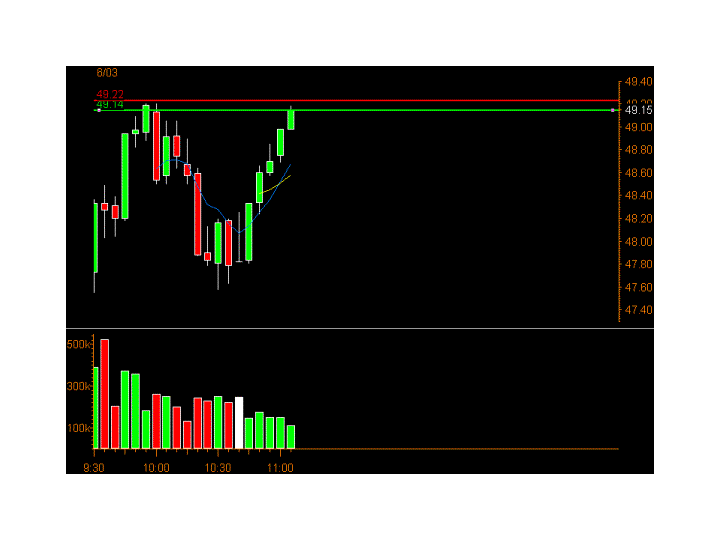
 Similiar to the morning QQQQ game it did the same thing here. My cue to exit my long was the lack of volume on the pop. Notice how the volume is lower on the last green up candle then the preceding one but the price kept rising. Only in bizarro world does that stick so it said to me sell the longs and go short. It dropped rather violently for 20 minutes after this.
Pay attention to these signals!
Get ready for the afternoon sesh, it may be a good one, lots of market movement today.


at the same time I shorted FTI below, I also shorted TNA. Same thing , I was waiting for the false uptrend to end. It was so obvious its like I had a crystal ball telling me what to do. Down it went. Perfect entry perfect exit
TNA short
TNA cover,profit taking and long
TNA sell, profit taking and short


Some good trading today. I woke up early this morning because I had something stuck in my tooth. Anyway, the markets looked weak so I took FTI short among others.
First chart is QQQQ after it does a no volume pop. I added to my postion here, chances were that it was going to drop. It did.
FTI short
FTI cover, taking profits and going long
Crash
keep on your toes, there is a lot of money to be made today while the markets are crashing
increase your size, push it, play the pops when they come.....
Tuesday, June 01, 2010
Tasty TNA part 2

 TNA continued to give good entries all day. 15 minute chart showed a doji at this point so a short back on the original trend suggested the best direction to trade in. Once momo took over, down it went.
TNA short entry
... profit taking 5 minutes before the day ends.
Buying bottoms


As much as I like to short the lows and buy the highs, sometimes a stock just screams out it is done dropping and is ready to reverse.
The near doji and huge volume on FTI said to me that the sellers were done for a while and the buyers were ready to take over. Then it was a short again
first chart FTI long
sold FTI
shorted FTI
cover FTI
Tasty TNA


With a small .01 spreads, huge volumes and large daily trading ranges , I find that trading the ETFs like TNA, FAZ, FAS, ERX and others provide everything that an active momo trader needs.
TNA today provided some tasty profits from clear signals with no hijinks. By the time I rolled in an hour after the open, TNA was making new highs but I could see that the strength of the move was waning. Then the Nasdaq test codes ZWZZT appeared on the new highs list first $2020 then the new lows $5. Sometimes this is a precursor to a big move. Possibly Nasdaq sees the orders lining up and want to test their operating system. Whatever the reason is, the markets fell. Watch for it and see for yourself.
First chart is TNA short entry
Second chart is cover and profit taking and went long
Sold the bounce and short again
Cover and profit taking
Friday, May 28, 2010
The Complete Trader.
What is the difference between a winning trader and a losing trader? It all comes down to attitude. Plus the winning trader makes it their career while the losing trader packs up their bag and disappears broken.
How do you get the right attitude? Where do you gain the skills necessary? Can previous winning experiences in a different field translate into additional self-confidence in the trading game? How long is this gestation period going to take? What details and secrets does it take to be a consistently successful trader? Is there a point in time that you will know all there is to know? How much is technical knowledge compared to self-mastery knowledge?
Attitude comes from within. Whether you think you can or cannot do anything, you are right. Every decision you make is one from free will. No one is forcing you to do anything at gunpoint. Your upbringing and outlook on life in general affect what kind of trader you are. Your point of view on money, value, work, winning, losing, wrong decisions, right decisions, happiness, sorrow, anger, fear, disgust, self pity, self worth, greed and a host of others are all rolled into either an arrow to help you along or a wall to stop you in place.
You can choose to have any reaction to whatever the markets may present to you. Maybe you will react as most people will. Maybe you will react differently. What is wrong or what is right depends on your attitude vis a’vis the markets.
As I see it you can control in general only 2 things while trading:
- The amount of money you lose in unprofitable trades when you set a stop loss.
2. The elements of your plan.
That’s it that’s all. The first one is easy. Enter a trade, set a stop. Barring extraordinary occurrences (as we have seen lately they do happen) you can precisely set the amount to lay on the line to test your trade ideas. The second one is the tricky bit. Your trading plan/system/edge is your foundation. It is comprised of both technical and emotional components. It is within your power to carry it out exactly as planned if you have the will to do so. It is not out of your control unless you choose to let it out. It’s up to you to follow and execute no matter what happens. To the degree you are swayed is the degree for improvement.
What can sidetrack you? Basic human emotions and lack of skills including the overall inability to cope with changing market conditions. Emotions such as fear and greed and all their associated feelings can sabotage your sincerest desires.
Acquiring the necessary skills should be done with no thought as to self imposed deadlines. First of all, beginners at any endeavour have no idea what so ever about what they even need to know. Trading is no exception. Certainly it is easy to have some winning trades right from the start and think you have this thing mastered. Market conditions frequently produce winning trades with hardly any effort at all. But when conditions change from strong to weak to sideways to chop and back again how are you going to cope if you really have no idea what to do. A beginning trader can lose their bank very quickly. Again it all comes back to you to realize what is going on and adapt to the conditions. But if you are beaten down, can you mount a comeback? Deep down inside do you have what it takes?
I can take some examples from sports and draw some parallels.
In tennis you can see the test of skills and wills clearly. One player gets the advantage and wears down the other. Slowly but surely unforced errors occur as the player behind tries to overcome the deficit. Have they lost the skills? No. Now it has become psychological in nature. One is getting beat. They are losing. Self-doubt creeps in. Their attitude has shifted from winning to losing. On the other hand the winning player feeds off the successes. They can see they have the upper hand. They can push it and show no mercy and try and pummel their opponent into the ground. They have the edge. Self confidence. Attitude.
Comeback wins do happen though and it takes supreme will power and control to force yourself to apply the system to best fit the conditions relentlessly.
Learning how to trade and manage yourself takes a lot of time. How long depends on the individual. I watched the markets and paper traded every day all day for two years before I felt I was ready to take on the professionals who have unlimited money and deep skills under all market conditions. Long markets, short markets, sideways markets all require different techniques to make consistent money in. In the very beginning how do you even know how to set your screens up. What information do you display? Then comes watching and being amazed at all the movement and colour. What about an edge, a plan, a system, taking profits, sizing, stops. This all takes many many instances of seeing and experiencing before it starts to sink in and become usable information. Why do you think flight simulators are so valuable in the aviation business? Because you can train for all conditions without crashing and burning. Over and over you can practice without getting killed. Crashing and burning as it relates to trading is to lose all your money and become psychologically damaged in the process. Your attitude will become a losing one.
Learning the technical aspects of trading and the markets takes time and what you think you know after 1,2, 3 years is nothing. Really, nothing. As the years roll by and you accumulate 1000’s of hours of seat time honing your edge and system you get to learn a few things about yourself as well. This is where you become a trader. And if you are humble, the learning never stops. To think otherwise is a recipe for disaster.
I wrote in one of my previous posts that trading is not about charts, chat rooms and technical indicators. It is about information and human emotions, real or not, that drive the prices and how best you can exploit them. The most important skill you can acquire is to master yourself. Trading wise that means to be able to do anything that you want to do at any time. You are in control of your emotions and let them work with your system and goals to become successful. The right action at the right moment based on the prevailing information and your intuition.
Confidence gets build into you when you see that you can do this thing. Winners make more winners. Unprofitable trades are only that. They are not taken as a bad reflection on yourself. Hesitation, self doubt, anger, sorrow, joy, fear, greed can all be mitigated by a winning attitude. The continual application of looking inwards at yourself is what will make an unshakable winning attitude and a complete trader.
Thursday, May 27, 2010


Wednesday, May 26, 2010
What is probability?


It is a greater likelihood of an event happening over an event not happening.
Here's the set setup from this morning. I traded TNA long from right before it went to new highs. It stalled out so I took profits and shorted it. Some good momo for a few candles then it stalled again. I didn't go long but only waited because the short momo seemed strong.
Lo and behold I saw a doji appear on the QQQQ at the 11:15 candle. That said the probability of it dropping more was greater than not. So I took TNA short, FAZ VXX long resulting in profitable trades. No other reasons. NO thinking.
First chart is QQQQ. Screen capture is a few candles late. Red lines are support/resistance lines I draw on when I start which not coincidentally is right where the doji appeared.
Second chart is TNA short
Third chart is TNA cover
Reader Q & A 5/26/10
Hey Scott,
I don't mean to spam you, but I have question about staying in a winning position. Is there a specific procedure you have for adjusting stops? I know trailing the highs/ lows of the previous candles works, but how do you make it through the pops and drops against your positions? I'm guessing you can kind of tell when they are weak/strong pushes, and that's something Ill learn with more observation. If you could shed some light on the topic I would appreciate it.
Thanks,
Aynul (avid reader)
Hi Scott,
Your most recent post on how you enter into a trade early was a real eye opener. I am currently going live trading futures with a small account. I paper traded based on your teachings...that is go with the flow of the market. So i trade with the trend once price touches the 20/30ema and then counter trend trade when i see strong divergence on my divergence indicator....always taking small profits and taking a small loss when i am wrong. One thing i have learnt from the exercise of taking numerous paper trades is that at the end of the day i will be profitable, but to make a bigger day is to add to the winning trades. Due to the small nature of my account i still suffer from fear of losing my capital and thus don't add to the winners. Now i will look at entering earlier and getting out for a smaller loss. I am using range bars but can work with minute bars too.
It is funny, since i was just thinking about this this morning and then i read your post. Lol, i think i am heading in the right direction...if i have started to think like you.
Reading your posts certainly opened my eyes to a lot of tricks/tips that i can use to minimize errors.
On another note, on average, how often during the day are you wrong and take a loss, and how do you add to winners? Also, how do you come back from an early morning big loss...i seem to always make a losing first trade and don't know how to get out of this pattern.
Thank you,
Anon
----------------------------------------------------------------------------------------------------------------------------------------------------------------------
I found these questions in my FNG email box which I rarely check , so sorry for the delay in answering them
Aynul- It all comes down to momentum. With a strong trending stock,I'll constantly move my stop in the direction of the move. I stick to using the near time momentum for stop levels with these as well. That means I keep the stop just under a pullback candle for a long position for example.
With faster moving stocks I'll usually keep it at the original stop level until the momo says it is finished, then cancel the stop and take profits. These faster stocks can really bounce around and it is easy to get taken out otherwise. So it is better to let the original premise for the trade stand. When you can gauge the momo correctly, you are not often stopped out.
Taking profits go hand in hand with stops though. You must have a plan to capitalize on the opportunities that come your way. Big candles are a sure signal to me to take profits regardless of what else is going on.
Anon- Worrying about losing money will actually attract losing trades to you. It's like telling yourself "Don't drop the toast on the floor" Of course then you proceed to drop it. Your sub conscious only hears the command "drop the toast" so it does.
When you can get into the flow and have confidence in your edge and trading plan, then the results will come. Adding to your winning trades even a little bit will eventually make you more successful. Just keep those losing trades small.
Depending on market conditions I take a few or many losing trades. They are always small though because when I stick to my system it does not let them grow big. Taking many small losing trades is normal in this business. It also makes perfect sense to add to the winning trades.That what a successful trader does.
If you are always getting a losing trade first thing in the morning, why don't you try paper trading th efirst couple of opportunities that come your way to get' warmed up" . Then start in with real money .
Monday, May 24, 2010
Using momentum to place stops


One technique I use with great success is to use momentum to show me where to place stops. I use something I call near time momentum. Near time momo is the the price level to which the stock fell or rose to just prior to when you enter the trade. It could be 1, 2 or 3 candles previously.
I have seen these momo levels ( you can't really call them support or resistance levels) survive over 1000's of trades. Upon entering the trade, it immediately goes in your direction and away from your stop. It's also called stress free trading. The fleeting moment between entering the trade and before it starts to move is the only time that your position is at risk.
I figure that since the price level wasn't breeched before it will take something else to happen before it will. Whatever information the markets and the stock was affected by then will have to change. Day traders have a big advantage if they can process what is happening in a timely manner and act accordingly. It is a matter of getting into the flow and letting it tell you how to trade with the direction of strength.
When you see these price levels and sense the momentum changing, you need to quickly enter the trade and set the stop a penny of two higher (or lower as the case may be).
Don't hesitate when you see the momo change or you will be putting on too much risk. Don't fumble with position sizing. You should already know what you either can play with or have left to play with beforehand. Don't be thinking about the reward as you or no one else knows where it is going to go. The only thing you can control is the risk. Do it, and fast with this technique. Like the majority of my trading, it doesn't require too much thinking, only observation.
Here's VXX from today that illustrates the concept.
First chart is entry, second chart is exit.
Subscribe to:
Posts (Atom)


 Posts
Posts

